

If you finished your WAEC, HND OR Bachelors Degree years ago, spent your NYSC service year working before you could apply, or simply took time off to save money and gain experience, you have probably typed the same worried question into Google: “how much study gap is acceptable in the UK?” It is one of the most common concerns we hear from Nigerian applicants at Jeropath International, and the honest answer is reassuring — the UK is one of the most gap-friendly study destinations in the world, provided you can explain your break clearly and back it up with documents.
In this guide, we break down exactly how many years of study gap UK universities typically accept at undergraduate and postgraduate level, which of our partner universities are known for accepting longer gaps, how Nigerian-specific situations like NYSC and WAEC resits are treated, and the exact documents you need to turn your “gap” into a strength rather than a weakness on your application.
What Exactly Is a “Study Gap”?
A study gap is simply the length of time between finishing your last qualification (for example, your WAEC/SSCE, National Diploma, HND, or bachelor's degree) and the date you plan to start your new course in the UK. It does not matter whether the break was your choice — working, NYSC, waiting for admission, family responsibilities, health, or finances all count.
What UK admissions teams and UK Visas and Immigration (UKVI) care about is not the number of years on its own, but whether you can account for that time in a clear, consistent, and well documented way.
How Much Study Gap Is Acceptable for Undergraduate Study in the UK?
For undergraduate (bachelor's degree) applicants, most UK universities are comfortable with a study gap of up to two years after your last qualification. This is the figure you will see repeated across almost every UK admissions office and study-abroad guide, and it holds true whether your last qualification was WAEC, A-Levels, or a foundation programme.
A gap slightly beyond two years is not an automatic rejection, but it usually means the admissions team will ask more questions — a small number of universities explicitly extend their published undergraduate allowance to around five years where the applicant provides a strong personal statement and a high IELTS score. As a general rule, though, the shorter and better documented your gap is at undergraduate level, the smoother your application will move.
How Much Study Gap Is Acceptable for a Master's Degree in the UK?
Postgraduate admissions are far more forgiving of a study gap — which is good news.
Across UK universities, a gap of up to five years between your bachelor's degree (or HND) and your Master's application is treated as completely normal, largely because postgraduate admissions teams expect applicants to have spent time working, doing NYSC, or building relevant experience before returning to study.
Gaps beyond five years are still very achievable. A number of universities will consider gaps of eight, ten, or even fifteen years for Master's applicants who can show consistent, relevant work experience, a clear reason for the break, and a strong Statement of Purpose (SOP). The single biggest factor admissions officers weigh is not the length of the gap itself, but whether your timeline is consistent and whether you were productively engaged — working, running a business, caring for family, or upskilling, rather than simply idle.
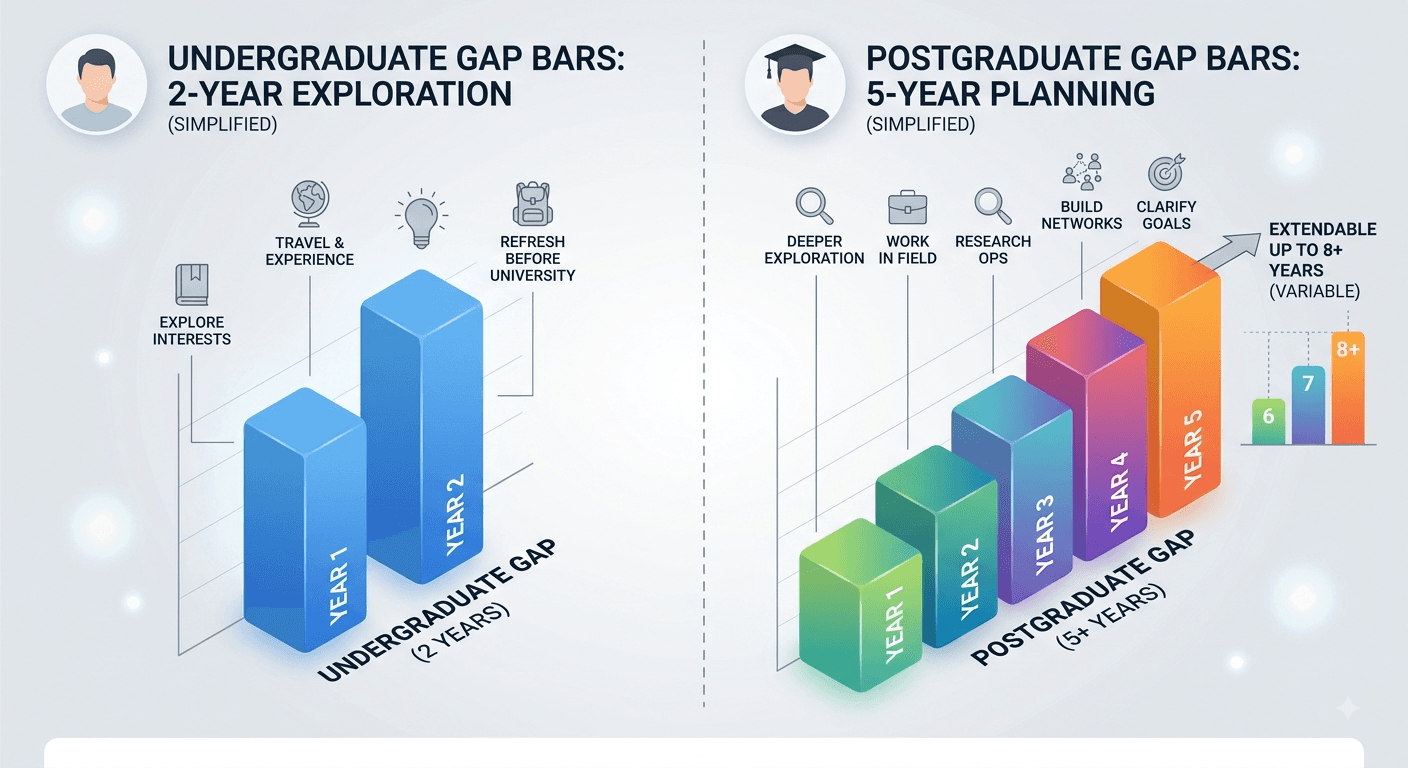
Quick Reference: UK Study Gap Limits by Course Level
Use this table as a general benchmark. Always confirm the specific policy of your target university, since individual admissions teams have the final say.
Recent UK Visa Climate: Why Genuineness Now Matters as Much as Gap Length
Before you shortlist universities, it's important to understand the environment you're applying into right now.
In September 2025, the Home Office cut the visa refusal threshold that UK universities must stay under — from 10% down to 5% — as part of a new Red-Amber-Green (RAG) compliance system for sponsor institutions, which took full effect from June 2026.
Expert Tip
Any university whose international student visa refusals rise above that 5% line risks losing its licence to recruit overseas students altogether.
This made 2026 a genuinely tougher year for Nigerian applicants.
Home Office data analysed by ICEF Monitor shows sponsored study visa refusal rates for Nigerian students climbed sharply to around 20% in the six months spanning late 2025 and early 2026, up from a lower annual average the year before, while UKVI has significantly increased “genuineness” scrutiny — asking more applicants detailed follow-up questions about their study plans, finances, and yes, their study gaps, before issuing a decision.
Nigeria was also named in industry reporting (alongside Pakistan, Bangladesh, Ghana, and Nepal) as one of the markets where a growing number of UK universities are now taking a more cautious, selective approach to recruitment, even where a full public pause hasn't been announced.
What this means practically: a study gap that would have been waved through in 2022 can now attract closer questioning in 2026 and beyond, not because the rules on gap length have changed, but because caseworkers and admissions teams are under far more pressure to justify every approval. A vague or inconsistent gap explanation is now a bigger liability than the gap itself.
This makes choosing a university with a genuinely fair, well-documented, evidence-based review process — and building a watertight SOP and document file — more important than at any point in the last decade.
Universities Known for Accepting Longer Study Gaps (UG & PG)
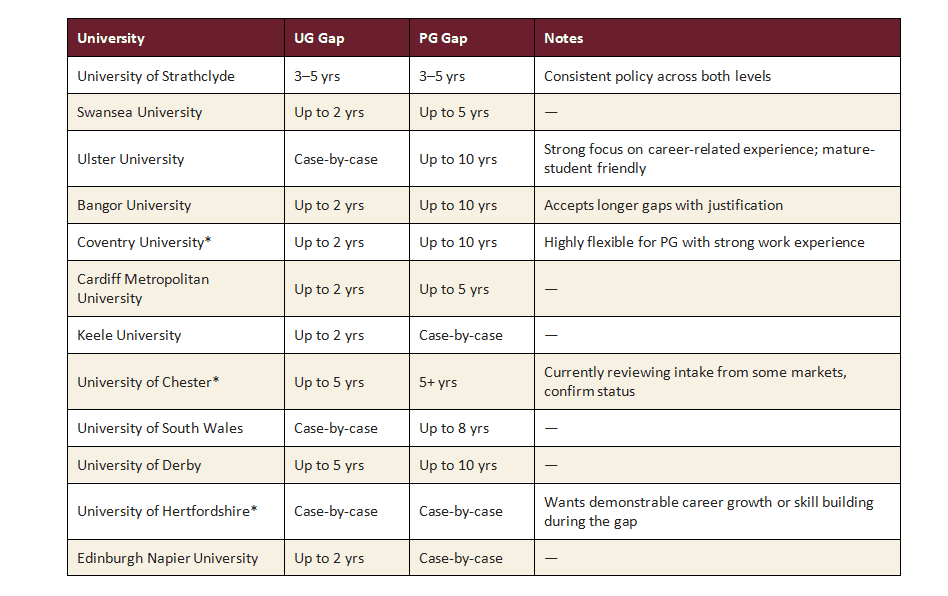
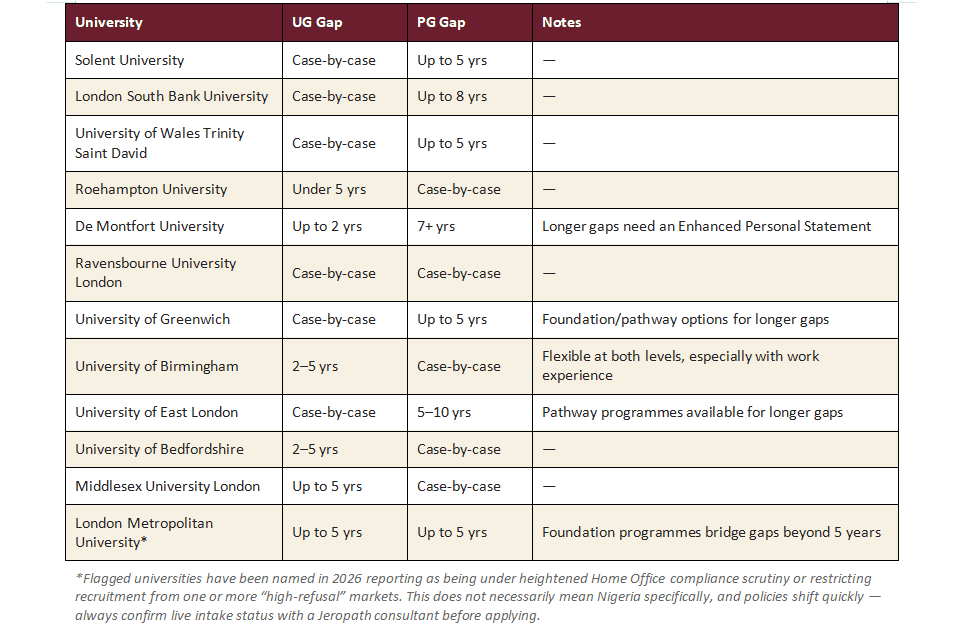
Gap-friendly doesn't automatically mean visa-safe in 2027
A university being flexible on study gap length is not the same as it having a stable, low-risk visa compliance record this year. Given how fast recruitment policies are shifting across the sector, Jeropath cross-checks each partner university's current intake status for Nigerian applicants before we recommend it — so you're not building your SOP and finances around a door that quietly closes.
Ask us for a live shortlist check before you applyCommon Study Gap Situations for Nigerian Students
The NYSC Year
Your one year National Youth Service is one of the easiest gaps to explain — it is a mandatory national programme, not a personal choice, and UK admissions teams are generally already familiar with it. Your NYSC discharge or exemption certificate is usually sufficient evidence on its own.
HND-to-Master's Applicants
Many Nigerian HND holders take 2 or more years to gain the work experience needed to qualify for a UK top-up degree or a Master's via a HND pathway. This time is almost always viewed positively, since it demonstrates exactly the kind of practical, sector relevant experience postgraduate admissions teams look for.
Waiting for JAMB/University Admission or WAEC Resits
A one- or two-year gap while re-sitting WAEC papers or waiting on a Nigerian university admission cycle is common and rarely raises concern, as long as you can briefly explain it in your personal statement.
Working Before a Master's
Spending two to five years in employment before applying for a Master's is, if anything, an advantage for postgraduate applications — particularly for MBA and management related courses, where relevant work experience is often an entry requirement rather than a red flag.
How to Justify Your Study Gap (So It Works in Your Favour)
Admissions officers and UKVI caseworkers are not trying to catch you out, they simply want a timeline that makes sense and is backed by paper. A well explained five year gap will always beat a vague, unexplained one year gap. Here is what strengthens a study gap explanation:
- Address the gap directly in your Statement of Purpose — one or two honest sentences are enough; do not leave the reader guessing.
- Show what you did with the time — frame work, NYSC, family responsibilities, or upskilling as purposeful, not as “doing nothing.”
- Connect the gap to your chosen course — explain how the experience gained actually supports your decision to study this specific programme now.
- Keep your documents consistent — dates on your CV, employment letters, and SOP should all line up without contradictions.
- Get a gap justification letter where relevant — some universities specifically request this as a short supporting document.
Documents That Help Explain a Study Gap
Jeropath International's review service checks your timeline for consistency, strengthens your justification, and aligns it with the exact university you're applying to — before it ever reaches an admissions officer.
Chat with a Jeropath consultant on WhatsApp to know what documents to prepareTurning an HND or Work Gap Into an Advantage
If your gap came from completing an HND and then working before applying, you are actually a strong candidate for several of our partner universities' HND-to-Master's pathways, which are specifically designed to bridge Nigerian HND qualifications into a UK postgraduate degree — often without requiring a separate top-up year. Combined with a documented work history, this pathway can turn what feels like a disadvantage into one of the more compelling parts of your application.
Common Mistakes That Get Study-Gap Applications Rejected
- Leaving the gap unexplained and hoping the admissions team won't notice
- Submitting a CV, SOP, and reference letter with mismatched or inconsistent dates
- Providing no documentary evidence at all for a gap longer than two years
- Applying to a university whose published policy does not fit your specific gap length
- Writing a generic SOP that never actually addresses the break in your timeline
- Assuming a university's past flexibility on gaps still applies today, without checking its current intake status for Nigerian applicants
- Giving inconsistent answers if UKVI calls you for a genuineness interview about your study plans or timeline
Frequently Asked Questions
Let Jeropath International Turn Your Study Gap Into a Strength
Whether your gap is 2 years or 12, our admissions team will match you with UK partner universities that genuinely accept your profile, help you write an SOP that explains your timeline with confidence, and guide you through your CAS and visa application from start to finish. Book a free consultation today and let's map out your UK study plan.
Book Free Consultation - WhatsApp Jeropath InternationalSources & Further Reading
- UK Government — Student visa: Overview (GOV.UK)
- UK Government — Student visa: Documents you'll need to apply (GOV.UK)
- UCAS — Student visas, immigration, and English language tests
- ICEF Monitor — UK sponsored study visa issuances down, rejection rates up
- ICEF Monitor — UK universities bracing for a further decline in international enrolments
- Times Higher Education — UK student visa refusal rates rise amid falling applicant numbers
- Vanguard News — UK universities face ban on recruiting Nigerian, other foreign students